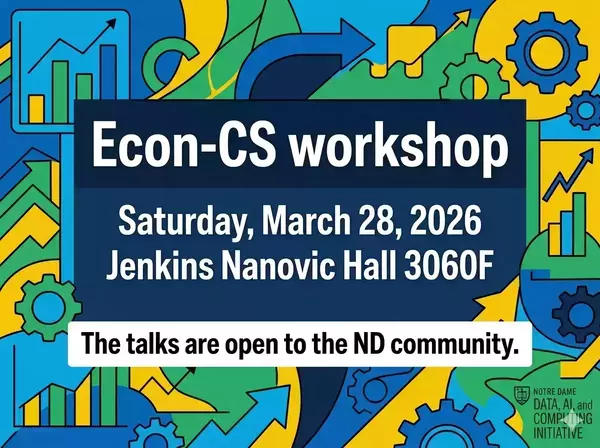
The workshop is organized by the Notre Dame Econ-CS Working Group and is supported by the University's Data, AI, and Computing (DAC) Initiative. This full-day event brings together scholars to share research at the intersection of economics and computer science.
The talks are open to the ND community. If you have any questions or plan to attend, please email Maciej Kotowski.
Saturday, March 28, 2026
* All scientific sessions are in Jenkins Nanovic Hall 3060F.
-
9:00am – 9:05am: Opening Remarks / Coffee & pastries available from 8:45am
-
9:05am – 9:55am: Matheus Ferreira (University of Virginia) — TBA
-
10:00am – 10:50am: Haifeng Xu (University of Chicago) — "The Interplay of AI and Economics: Some Vignettes and Lessons"
-
11:00am – 11:50am: Nicole Immorlica (Yale University) — "Agentic Markets – Equilibrium Effects of Improving Search"
-
12:00pm – 2:00pm: Lunch (by invitation)
-
2:15pm – 3:05pm: Strategic Roadmap & Panel Discussion
-
3:10pm – 4:00pm: Rad Niazadeh (University of Chicago) — "Dynamic Matching for Refugee Resettlement"
-
4:10pm – 5:00pm: Juba Ziani (Georgia Tech) — "How Differential Privacy Shapes Incentives in Data Sharing"
-
5:00pm – 5:05pm: Closing Remarks & Wrap-up
Abstracts
Matheus Ferreira (University of Virginia)
“TBA”
Haifeng Xu (University of Chicago)
“The Interplay of AI and Economics: Some Vignettes and Lessons”
Abstract: AI and Large Language Models (LLMs) are often framed primarily as challenges of data and computation. In this talk, we argue that economic principles provide a fundamentally new lens for designing and understanding AI systems. Drawing on several recent research threads from our lab, we illustrate how ideas from economics can drive meaningful advances in AI, along with key lessons learned along the way. These include leveraging mechanism design to optimize incentives for content creators—resulting in real-world pilot tests on Instagram involving millions of users—and building new frontier of LLM reasoning intelligence by employing real-world markets as open, uncontrollable benchmarks.
Nicole Immorlica(Yale University)
“Agentic Markets – Equilibrium Effects of Improving Search”
Abstract: Motivated by advances in AI agents, we study the impact of improved search technology on learning and welfare in agentic markets. Consumers engage in costly search to acquire signals of product fit prior to purchase. The market aggregates observations— indications of fit for searched products and indications of quality for chosen products—thereby guiding future searches. We characterize the long-run steady-state of the resulting dynamics and study the impact of improving search technology. We find cheaper search improves learning and consumer surplus, whereas more informativeness can degrade both —unless the market learns as much as consumers about the products, e.g., by “reading the transcript” of agentic conversations. Finally, we consider the impact of search on how businesses set prices. In symmetric markets, market efficiency improves when search is cheaper and/or more informative. However, more informative search may decrease consumer surplus as it weakens competition.
Based on joint work with Brendan Lucier, Markus Mobius, Alex Slivkins, Dan Goldstein, Jake Hofman, Sonia Jaffe and David Rothschild from the MSR Economics and Computation/CSS group.
Rad Niazadeh (University of Chicago)
“Dynamic Matching for Refugee Resettlement”
Abstract: Refugee resettlement is an international effort that aims to provide a durable solution for the current global refugee crisis. The goal is to help refugee families to find a new home in a host country and eventually find a new job to get “resettled.” In this talk, I will discuss our recent paper in partnership with a major national agency working on refugee resettlement in the United States. In this work, we re-design the core dynamic matching algorithm used by our partner, for sequential yearly assignment of refugee cases to our partner's affiliate locations. These localities should be thought of as service centers providing vocational services or assistance with job search, and many times are short in staff. I discuss various operational intricacies in this dynamic matching problem, such as lack of reliable arrival prior data, predicting employment outcomes of each match, and controlling backlogs in those service centers. I also discuss regulatory constraints imposed on the problem, such as family re-unification ties for refugees and their implications on our algorithm. Then I will introduce a new algorithmic framework to study this problem, through which I show how to design and analyze near-optimal learning-based primal-dual algorithms that aim to maximize employment outcomes while respecting operational and regulatory constraints in this problem. Time permits, I'll discuss a case study for evaluating the empirical performance of our algorithms using our partner's data and discuss some details of our collaboration.
The talk is based on the paper “Dynamic Matching with Post-allocation Service and its Application to Refugee Resettlement” (forthcoming in Management Science, and preliminary conference version in ACM EC 2024): https://papers.ssrn.com/sol3/
Juba Ziani (Georgia Tech)
“How Differential Privacy Shapes Incentives in Data Sharing”
Abstract: Many data-driven decisions rely on combining data held by multiple independent actors who differ in their willingness to share sensitive information. While differential privacy is often regarded as a gold standard for privacy in statistical analysis and learning tasks, much less is understood about how privacy choices shape incentives to participate and contribute data when participation is voluntary.
This talk takes an economic and incentive-centric view of differential privacy in collaborative and federated data-sharing environments. I study settings in which participation is voluntary, and privacy protection affects agents’ incentives, trading off learning benefits—which improve as more data are pooled—against privacy dis-utilities from sharing sensitive information. The talk analyzes both centralized designs, in which a platform commits to a (potentially personalized) privacy policy and agents decide whether to participate, and decentralized designs, in which agents jointly determine participation and form data-sharing coalitions through direct interactions.
Based on joint work with Rachel Cummings, Hadi Elzayn, Vasilis Gkatzelis, Manolis Pountourakis, and with Raef Bassily, Kate Donahue, Diptangshu Sen, and Annuo Zhao.